
In the world of industrial automation and large-scale manufacturing, the transition from a supplier’s workshop to a client’s facility is a high-stakes phase. Factory Acceptance Testing (FAT) and Site Acceptance Testing (SAT) are the critical milestones that ensure a system meets its design specifications.
However, many projects suffer from a “death by a thousand cuts” during these phases, where minor errors lead to significant rework, blown budgets, and missed deadlines. Industry data suggests that by optimizing your documentation and validation processes, you can reduce rework by as much as 30%.
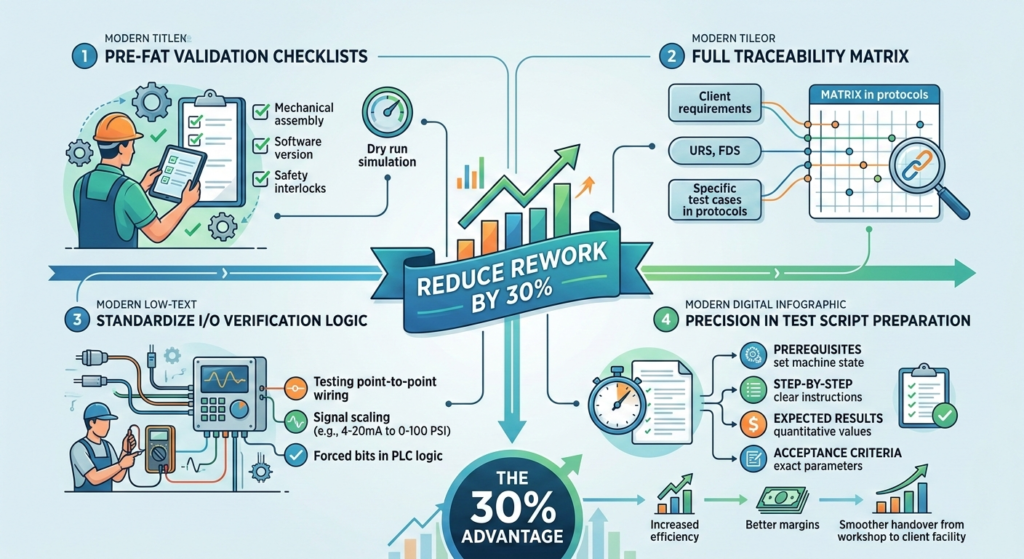
Here is how to streamline your FAT & SAT documentation for maximum efficiency.
The High Cost of Inadequate Documentation
Rework during the commissioning phase isn’t just a technical hurdle; it’s a financial drain. When a system fails a test during FAT, the engineers must diagnose, fix, and re-test. If that failure isn’t caught until SAT—when the machine is already at the client’s site—the costs of travel, downtime, and emergency shipping can skyrocket.
The secret to avoiding this lies in proactive documentation. By shifting the focus from “testing to find bugs” to “validating a ready system,” teams can ensure a smooth handover.
1. Eliminate Surprises with Pre-FAT Validation Checklists
The most common reason for FAT failure is arriving at the test day with a system that hasn’t been internally vetted. Implementing rigorous pre-FAT validation checklists is the single most effective way to reduce rework.
A pre-FAT checklist acts as a “dry run.” It ensures that:
- All mechanical components are assembled and torqued.
- Software versions are finalized and backed up.
- Safety interlocks are functioning.
- The physical appearance matches the General Arrangement (GA) drawings.
By checking these boxes internally before the client arrives, you ensure that the formal FAT is a demonstration of success rather than a troubleshooting session.
2. Ensure Full Coverage with a Traceability Matrix
How do you prove that every single client requirement has been met? Without a traceability matrix, it is easy for a small functional requirement to slip through the cracks, only to be discovered during the final SAT.
A traceability matrix maps every User Requirement Specification (URS) and Functional Design Specification (FDS) to a specific test case in your FAT or SAT protocol.
- Bidirectional visibility: If a requirement changes, you immediately know which test scripts need updating.
- Gap analysis: It highlights requirements that currently have no corresponding test, preventing “missing feature” rework at the site.
3. Standardize I/O Verification Logic
One of the most time-consuming aspects of commissioning is hardware-to-software communication. Errors in I/O verification logic—such as swapped wires or incorrectly scaled sensors—are notorious for causing delays.
To reduce rework, your documentation should include a dedicated I/O checkout sheet that validates the logic before functional testing begins. This includes:
- Point-to-point wiring checks: Ensuring the physical wire matches the electrical schematic.
- Signal scaling: Verifying that a 4-20mA signal correctly translates to the intended engineering units (e.g., 0-100 PSI) in the PLC logic.
- Forced bit testing: Systematically forcing inputs and outputs to ensure the software responds according to the design logic.
Fixing these “low-level” errors early ensures that the “high-level” functional testing proceeds without interruption.
4. Precision in Test Script Preparation
A test is only as good as the script that guides it. Vague documentation leads to subjective results, which often results in the client requesting rework based on a misunderstanding of the system’s capabilities.
Effective test script preparation requires a granular approach. Each script should include:
- Prerequisites: What state must the machine be in before the test starts?
- Step-by-step instructions: Clear actions for the operator.
- Expected results: Quantitative values or specific visual cues that define a “Pass.”
- Acceptance criteria: The exact parameters that satisfy the requirement.
When test scripts are prepared with this level of detail, it removes ambiguity. If the machine does exactly what the script says, and the client signed off on the script, the “rework” conversation is replaced by an “out-of-scope” conversation.
Conclusion: The 30% Advantage
Reducing rework by 30% is not about working faster; it is about working smarter through documentation. By utilizing pre-FAT validation checklists, maintaining a rigorous traceability matrix, verifying I/O verification logic early, and putting effort into test script preparation, you create a “right-the-first-time” culture.
High-quality documentation transforms FAT and SAT from stressful hurdles into professional demonstrations of quality, ultimately protecting your profit margins and your reputation.