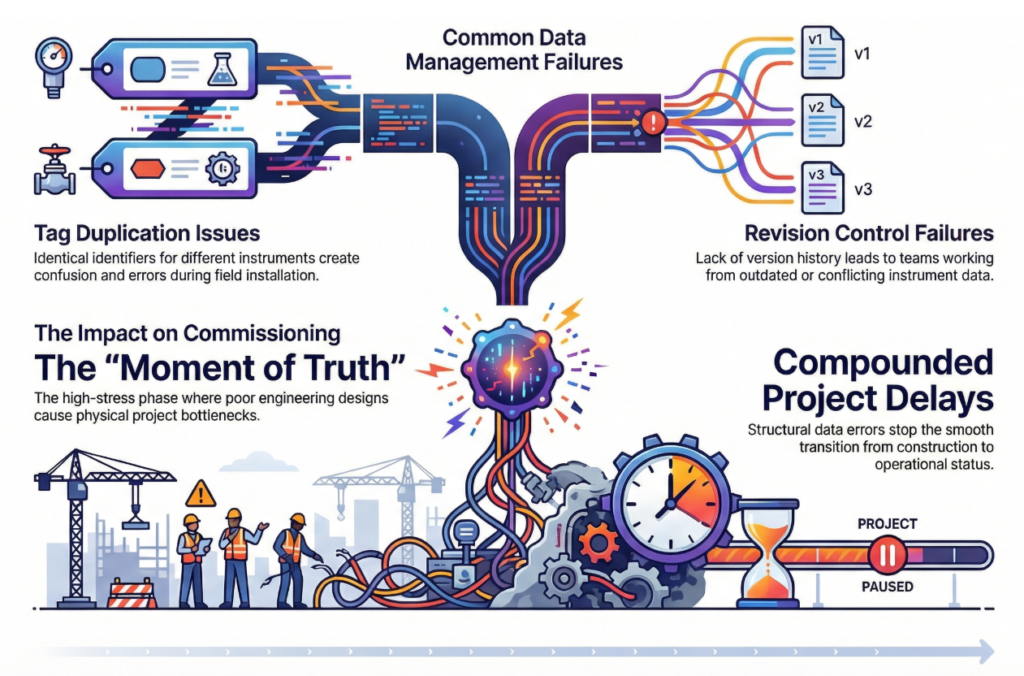
In the world of industrial automation and process control, communication is everything. When an engineer in Texas designs a system for a refinery in Singapore, there can be no room for “creative interpretation.” This is where standardized instrumentation symbols and documentation come into play.
To ensure safety, efficiency, and clarity, the industry relies on standards developed by the International Society of Automation (ISA). Specifically, ISA-5 and ISA-20 serve as the backbone for how instruments are represented visually and documented technically.
The Language of the Plant: Understanding ISA-5
ISA-5 (specifically ISA-5.1) is the global standard for instrumentation symbols and identification. If you have ever looked at a Piping and Instrumentation Diagram (P&ID) and seen circles, squares, and lines with cryptic letter codes, you were looking at ISA-5 in action.
1. Tag Numbers and Identification
Under ISA-5, every instrument is assigned a unique tag number. This tag typically consists of a series of letters and numbers:
- First Letter: Indicates the measured or initiating variable (e.g., T for Temperature, L for Level, P for Pressure).
- Succeeding Letters: Indicate the function of the instrument (e.g., IC for Indicator Controller, V for Valve).
- Loop Number: A numerical suffix that identifies the specific control loop.
For example, a tag labeled TIC-101 tells an operator that the device is a Temperature Indicating Controller belonging to loop 101.
2. Graphic Symbols
ISA-5 defines the “bubbles” or shapes used to represent instruments based on their location and accessibility:
- Discrete Instruments: A simple circle indicates a field-mounted instrument.
- Shared Display/Control: A circle inside a square indicates the instrument is part of a Distributed Control System (DCS) or PLC, accessible via an operator console.
- Computer Function: A hexagon represents a computer-calculated function.
3. Line Symbols
The lines connecting these symbols also carry specific meanings. A solid line represents a process connection (piping), while a dashed line indicates an electrical signal (4-20mA). A line with “double cross-hatches” represents a pneumatic signal.
The Blueprint of Specs: Understanding ISA-20
While ISA-5 provides the visual “map” of the process, ISA-20 provides the “biography” of each instrument. ISA-20 focuses on Instrument Specification Forms (often called Data Sheets).
Once an instrument is identified on a P&ID using ISA-5, the procurement and maintenance teams need to know the specific technical details of that device. This is where ISA-20 comes in.
Why ISA-20 is Critical
A data sheet following ISA-20 standards ensures that all stakeholders—from the design engineer to the vendor—are looking at the same technical requirements. An ISA-20 form typically includes:
- Operating pressure and temperature ranges.
- Materials of construction (e.g., Stainless Steel 316).
- Connection sizes and types.
- Manufacturer and model numbers.
- Calibration requirements.
Without the structure of ISA-20, specification sheets would be inconsistent, leading to the purchase of incorrect equipment, which causes costly project delays and potential safety hazards.
Why Standardization Matters
The integration of ISA-5 and ISA-20 into industrial workflows is not just about following rules; it’s about risk mitigation.
1. Safety and Emergency Response
In an emergency, an operator must be able to glance at a screen or a printed diagram and immediately identify which valve to close. Standardized symbols ensure there is no hesitation or confusion during critical moments.
2. Streamlined Maintenance
When a technician is sent to calibrate a transmitter, the ISA-5 tag tells them where it is and what it does, while the ISA-20 data sheet tells them how to calibrate it and what the expected output should be.
3. Interoperability Between Teams
Large-scale projects involve multiple contractors, vendors, and engineers. Using ISA-5 and ISA-20 creates a universal language that allows a seamless handoff from the design phase to the construction and operational phases.
Best Practices for Instrumentation Documentation
To get the most out of these standards, organizations should follow these best practices:
- Consistency is Key: Ensure that every P&ID and data sheet follows the same version of the ISA standards. Mixing old and new symbols can lead to confusion.
- Use Modern CAD Software: Most modern Engineering Design Tools (EDT) have built-in libraries for ISA-5 symbols, which automates the tagging process and reduces human error.
- Regular Audits: Periodically review “As-Built” documentation against the physical plant. Over years of maintenance, “ghost” instruments may appear on drawings that no longer exist in the field.
- Training: Ensure that all plant personnel, not just engineers, have a basic understanding of how to read ISA-5 symbols.
Conclusion
Mastering ISA-5 and ISA-20 is essential for anyone involved in the design, operation, or maintenance of industrial processes. ISA-5 provides the visual framework needed to understand the “what” and “where” of plant instrumentation, while ISA-20 provides the technical depth to understand the “how.” Together, they form a robust system of documentation that ensures industrial plants run safely, efficiently, and predictably.