
Instrument Tagging Philosophy: Are you doing it right?

In the world of industrial automation and process control, an instrument tag is more than just a label on a data sheet or a physical plate wired to a transmitter. It is the “DNA” of the plant. A robust instrument tagging philosophy ensures that every sensor, valve, and controller can be uniquely identified, located, and maintained throughout its lifecycle.

As a Senior Instrumentation Engineer, I have seen firsthand how a lack of standardization in the early stages of a project can lead to catastrophic delays during commissioning and maintenance nightmares during operations. To prevent this, we must build systems that are logical, consistent, and capable of providing support for large-scale projects.

The Foundation of Tag Naming: Why It Matters

Tag naming is the process of assigning a unique alphanumeric code to an instrument. This code communicates the instrument’s function, its location within the process, and its relationship to other components. Without a clear philosophy, you end up with “Frankenstein” systems where different areas of the same plant use different naming conventions.

A logical tagging system provides:

  1. Seamless Communication: Engineers, operators, and maintenance technicians all speak the same language.
  2. Efficient Data Management: Simplified integration with Asset Management Systems (AMS) and Computerized Maintenance Management Systems (CMMS).
  3. Faster Troubleshooting: When an alarm trips, the tag should immediately tell the operator what the device is and where it is located.

Leveraging Industrial Standards

To achieve true standardization, we don’t need to reinvent the wheel. Several industrial standards provide the framework for professional tagging.

ISA 5.1: The Global Benchmark

The International Society of Automation (ISA) 5.1 standard is the most widely used convention in the oil and gas and chemical industries. It uses a combination of letters (to define the measured variable and function) and numbers (to define the loop). For example, a “PT-101” is a Pressure Transmitter in loop 101.

KKS (Kraftwerk-Kennzeichensystem)

For power generation and complex heavy industries, the KKS system is often the gold standard. Unlike the flatter structure of ISA, KKS is a hierarchical system that identifies the plant level, the system level, and the component level. This hierarchy is essential for support for large-scale projects where thousands of identical components exist across different units.

Building a Scalable Philosophy

When designing a tagging philosophy for a new facility, scalability is the most critical factor. A system that works for a small pilot plant will often fail when applied to a multi-train refinery.

1. Hierarchical Structuring

A scalable tag should follow a “General to Specific” logic. A common structure includes:

  • Unit/Area Code: (e.g., 10 for Crude Distillation)
  • Equipment Type: (e.g., FV for Flow Valve)
  • Loop Number: (e.g., 5001)
  • Suffix: (e.g., A/B for redundant systems)

2. Consistency Across Documentation

The tag must be identical across the P&ID (Piping and Instrumentation Diagram), the Instrument Index, the wiring diagrams, and the HMI (Human Machine Interface). Any discrepancy—even a misplaced hyphen—can lead to procurement errors and safety risks.

3. Future-Proofing

Always leave “gaps” in your numbering sequences. If you number your loops 101, 102, and 103, you have no room to add a new instrument between them later. Using increments of 10 (100, 110, 120) allows for future expansion without breaking the logical flow.

Challenges in Large-Scale Projects

Providing support for large-scale projects requires a centralized “Tag Registry.” In projects involving multiple EPC (Engineering, Procurement, and Construction) contractors, a lack of a unified tagging philosophy leads to duplicate tags.

To mitigate this, the Lead Instrumentation Engineer must establish a Tagging Master Specification at the FEED (Front-End Engineering Design) stage. This document should dictate:

  • Character length limits.
  • Mandatory use of delimiters (dashes, underscores).
  • Prohibited characters (to avoid software glitches in DCS/PLC systems).

Conclusion: The ROI of a Strong Philosophy

Developing a comprehensive instrument tagging philosophy requires an upfront investment of time and discipline. However, the return on investment is realized through reduced engineering hours, faster commissioning, and enhanced plant safety.

By adhering to industrial standards like ISA 5.1 or KKS and prioritizing standardization, you create a digital twin foundation that will serve the plant for decades. Remember: a tag is not just a name; it is a vital piece of information that keeps the industrial world turning.

Are you planning a new facility or upgrading an existing one? Ensure your tagging system is ready for the challenge. Contact our engineering team today to learn more about implementing scalable industrial standards.
Why Poor Instrument Index Structure Delays Commissioning

Discover how a poorly structured instrument index leads to project delays. Learn about tag duplication issues, revision control failures, and real commissioning chaos examples.

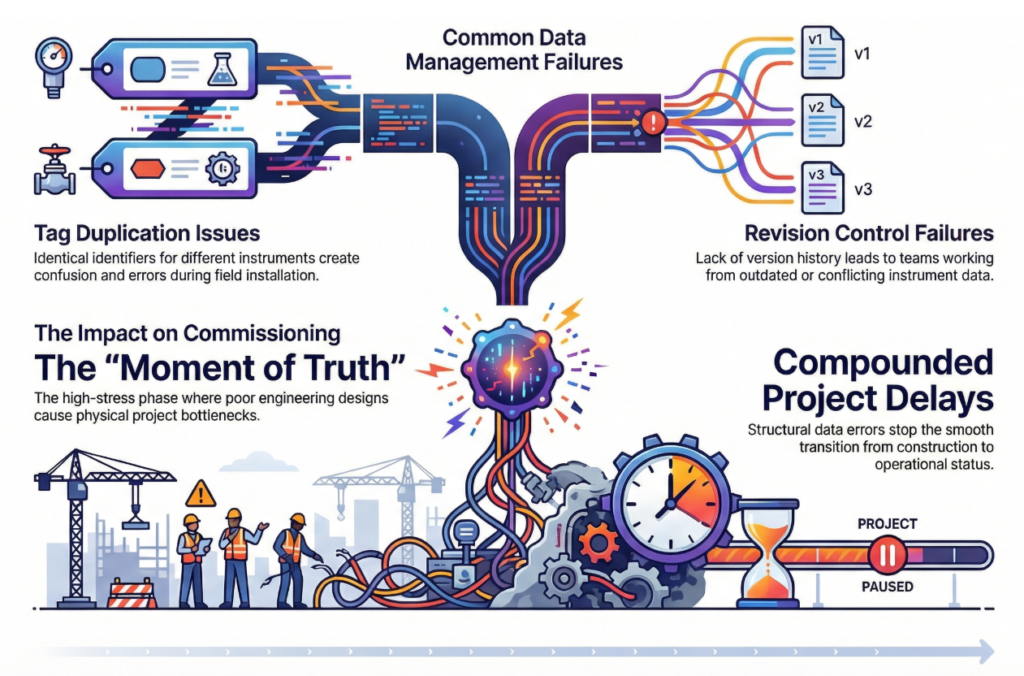
The transition from construction to commissioning is often the most stressful phase of any industrial project. It is the moment of truth where engineering designs meet physical reality. At the heart of this transition lies a single, critical document: the Instrument Index.

When structured correctly, the index is a roadmap to success. When managed poorly, it becomes a primary source of project stagnation. In this article, we explore why a weak data structure leads to significant delays and how to avoid the most common pitfalls.

The Foundation of Commissioning Success

An instrument index is more than just a list of parts; it is the “source of truth” for every sensor, valve, and transmitter on-site. If the data architecture is flawed from the start, the errors cascade through procurement, installation, and finally, loop checking.

Tag Duplication Issues: The Silent Budget Killer

One of the most frequent results of a poor index structure is tag duplication issues. In large-scale projects involving thousands of components, it is remarkably easy for two different instruments to be assigned the same tag number—or for one physical instrument to be assigned two different tags in different documents.

When duplicates exist:

  • Procurement may double-order expensive equipment.
  • Warehouse teams struggle to issue the correct parts to the field.
  • Software engineers face database conflicts when configuring the Distributed Control System (DCS).

Without a rigid naming convention and a centralized database, these duplications often remain hidden until a technician attempts to install a device that “technically” doesn’t exist in the system.

Revision Control Failures and Data Integrity

In the fast-paced environment of engineering, changes are inevitable. However, revision control failures turn these changes into nightmares. If the instrument index is managed via disconnected spreadsheets rather than a controlled database, “Version 5” for the electrical team might be “Version 2” for the process team.

When a field engineer is working off an outdated revision:

  1. They may install an instrument with the wrong pressure rating.
  2. They might wire a device based on a discarded terminal plan.
  3. Loop testing fails because the expected signal range in the control room doesn’t match the physical device.

These failures require hours of “re-work,” which is significantly more expensive than doing it right the first time.

Multi-Discipline Interface Problems

Instrumentation does not exist in a vacuum; it sits at the crossroads of piping, process, electrical, and mechanical engineering. Multi-discipline interface problems arise when the instrument index lacks the necessary fields to bridge these departments.

For example, if the index doesn’t clearly communicate the orifice plate size to the piping team or the power requirements to the electrical team, physical clashes occur. We often see junction boxes placed in inaccessible locations or cable trays that are undersized because the instrument count was not synchronized across disciplines.

Real Commissioning Chaos Examples

To understand the impact, let’s look at some real commissioning chaos examples seen in the field:

  • The “Ghost” Valve: On a major LNG project, a lack of index synchronization led to 50 control valves being manufactured with the wrong fail-safe position. This wasn’t discovered until the loop check phase, delaying the start-up by three weeks while actuators were retrofitted on-site.
  • The Loop Check Logjam: A refinery project suffered a month-long delay because the instrument index didn’t match the P&IDs (Piping and Instrumentation Diagrams). Technicians spent more time hunting for “missing” instruments than actually testing loops, leading to a complete halt in the commissioning schedule.

How to Protect Your Schedule

Avoiding these delays requires a proactive approach to data management. To ensure a smooth commissioning phase, projects should:

  1. Utilize an Integrated Database: Move away from static spreadsheets to a dynamic, multi-user environment (like SPI/InTools).
  2. Enforce Strict Validation: Implement automated checks to prevent tag duplication.
  3. Standardize Early: Define the instrument index structure before a single tag is generated.
  4. Audit Regularly: Perform cross-discipline audits to ensure the index matches the P&IDs and wiring schematics.

Conclusion

A poor instrument index structure is a ticking time bomb. By addressing tag duplication issues, fixing revision control failures, and resolving multi-discipline interface problems, you can prevent the real commissioning chaos examples that derail budgets and timelines.

Invest in your data structure today, or you will pay for it during the final—and most expensive—hours of your project.

Need structured instrument index support?

7 Common Mistakes in I/O Lists (That Cost Projects Money)

Avoid project delays and budget overruns. Learn the 7 common mistakes in I/O list development, from missing signal types to SIS vs BPCS misclassification.

In the world of industrial automation and process control, the I/O (Input/Output) list is the “DNA” of the project. It dictates the hardware requirements, the control cabinet design, and the software configuration.

Despite its importance, I/O list development is often rushed or delegated to junior engineers without proper oversight. This leads to errors that don’t surface until the procurement or commissioning phase—where they suddenly become incredibly expensive to fix.

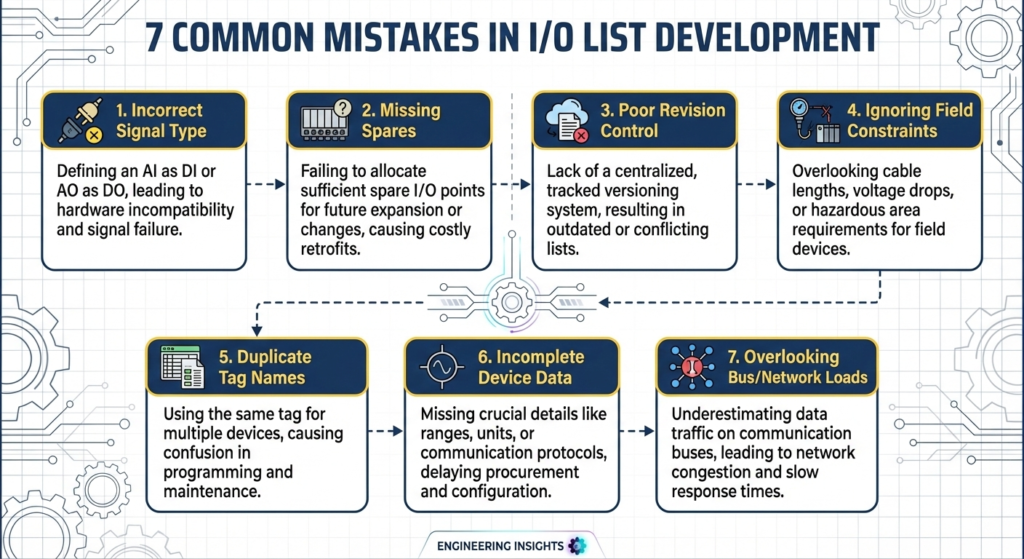
Here are the seven most common mistakes in I/O list development that cost projects money.

1. Missing Signal Types

One of the most frequent errors is documenting a tag without specifying the exact signal type. Is that temperature transmitter a 4-20mA Analog Input (AI), or is it a direct RTD/Thermocouple connection?

Missing signal types lead to incorrect I/O module procurement. If you order a standard AI card but your field instruments require HART protocol or high-speed counters, you’ll face “Change Orders” that can stall a project for weeks while you wait for new hardware.

2. Wrong Fail-Safe Definitions

How should a valve behave when power is lost? How should a motor respond if the control signal is cut?

Wrong fail-safe definitions (confusing Normally Open vs. Normally Closed or De-energize to Trip vs. Energize to Trip) are safety hazards. If the I/O list specifies a “Fail-Close” valve as “Fail-Open,” the entire logic and wiring must be reworked. Correcting these errors during the Factory Acceptance Test (FAT) is expensive; correcting them during commissioning is a disaster.

3. SIS vs. BPCS Misclassification

This is perhaps the most critical error on the list. SIS vs. BPCS misclassification occurs when a safety-critical signal is mistakenly assigned to the Basic Process Control System (BPCS) rather than the Safety Instrumented System (SIS).

Safety signals require specific SIL-rated hardware and separate physical infrastructure. If you realize mid-project that a “standard” pressure transmitter should actually be part of an Emergency Shutdown (ESD) loop, you aren’t just changing a line in a spreadsheet—you are changing the entire architecture of the control system.

4. No Signal Grouping Logic

An I/O list shouldn’t just be a random collection of tags. No signal grouping logic results in a “spaghetti” layout in your marshalling cabinets.

Signals should be grouped logically by:

  • Process Area
  • Signal Type (Analog vs. Digital)
  • Voltage Level (24VDC vs. 120VAC)
  • Hazardous Area Classification (IS vs. Non-IS)

Without this logic, cable routing becomes a nightmare, and maintenance teams will struggle to troubleshoot the system for years to come.

5. Overlooking Spare Capacity

In an effort to save on initial hardware costs, many developers fail to account for “Growth Capacity.” A standard best practice is to include 20% spare capacity at every stage: spare terminals, spare I/O points, and spare cabinet space.

If your I/O list is “maxed out” from day one, the first time a field change occurs (and it will occur), you will be forced to add new cabinets and modules at a premium price.

6. Inconsistent Tagging and Naming

If the I/O list doesn’t match the P&IDs (Piping and Instrumentation Diagrams), confusion is inevitable. Inconsistent tagging leads to “lost” signals where the software engineer creates a block for a tag that doesn’t exist in the field. This disconnect results in hundreds of man-hours spent cross-referencing documents to find out where a specific wire actually goes.

7. Lack of Revision Control

The I/O list is a living document. Using a file named IO*List*Final*v2*Updated*USE*THIS.xlsx is a recipe for failure. Without a formal revision control process, the electrical team might be wiring panels based on Version 3, while the programmers are writing code based on Version 5.

The cost of “re-doing” work because of a version mismatch is one of the most avoidable expenses in project management.


Conclusion: Getting it Right the First Time

The I/O list is more than just a spreadsheet; it is the foundation of your entire automation infrastructure. By ensuring you have clear signal grouping logic, accurate SIS vs BPCS misclassification, and precise fail-safe definitions, you can prevent the “death by a thousand cuts” that ruins project budgets.

Investing time in a thorough I/O list review during the FEED (Front-End Engineering Design) stage is the best way to ensure a smooth, cost-effective startup.