
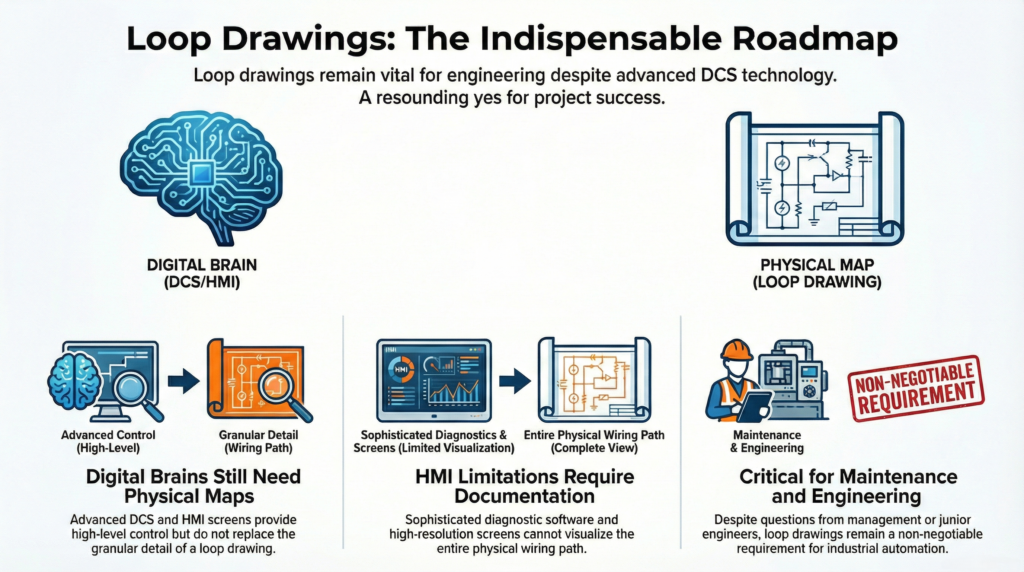
In the modern era of industrial automation, the Distributed Control System (DCS) is the brain of the plant. With high-resolution HMI screens, sophisticated diagnostic software, and digital fieldbus protocols, some managers and junior engineers have begun to ask: “Do we really still need loop drawings?”
The short answer is a resounding yes. While the DCS manages the logic and the data, the physical reality of the plant—the wires, terminal blocks, barriers, and junctions—remains analog and physical.
As an E&I engineer, I have seen firsthand how the absence of accurate loop drawings can turn a minor instrument failure into a multi-hour production outage. Here is why loop drawings remain the “DNA” of your facility and how to manage the documentation burden in today’s lean engineering environment.
The Bridge Between Software and Reality
A DCS can tell you that a 4-20mA signal is out of range, but it cannot tell you that a technician accidentally bumped a loose wire in Junction Box 42.
Loop drawings (typically following the ISA-5.4 standard) provide a detailed roadmap of the signal path from the field instrument to the I/O card. This includes:
- Terminal numbers in the field junction box.
- Multi-pair cable identification.
- Marshalling cabinet terminations.
- Intrinsic safety (IS) barrier details.
- DCS I/O channel assignments.
Without this “map,” troubleshooting is reduced to guesswork. In a high-stakes environment, guessing is not a strategy; it is a liability.
Navigating Staff Overload Cycles
One of the primary reasons loop drawings fall out of date is the reality of staff overload cycles. In many plants, the E&I department is sized for “steady-state” maintenance. When the plant is running smoothly, documentation is manageable.
However, when a major failure occurs or a small optimization project is launched, the engineering team is stretched thin. During these cycles, “redlining” a drawing is often the first task to be deferred. Over several years, these deferred updates accumulate, rendering the plant’s documentation library untrustworthy. When the drawings don’t match the field reality, safety risks increase and troubleshooting time doubles.
Managing Temporary Project Peaks
Capital projects and plant turnarounds create massive temporary project peaks in documentation requirements. A single project might add 200 new loops to the system. Producing, checking, and approving 200 individual drawings requires hundreds of man-hours that most internal teams simply do not have.
During these peaks, the pressure to “just get the plant running” often leads to a backlog of “as-built” drawings that never actually get built. This creates a technical debt that the maintenance team will eventually have to pay—usually at 2:00 AM during an emergency shutdown.
The Cost of Permanent Hires vs. Scalable Solutions
From a management perspective, the cost of permanent hires is a significant barrier to maintaining perfect documentation. Hiring a full-time E&I designer or CAD operator is a long-term financial commitment that includes salary, benefits, training, and software licensing.
For many facilities, the workload for documentation is “lumpy.” There isn’t enough work to justify a new full-time employee year-round, but there is too much work for the existing staff to handle during upgrades. This leads to a cycle of “documentation decay,” where the quality of the plant’s records slowly erodes because the cost of maintaining them seems too high.
Modern Solutions: Remote Documentation Workflows
To bridge the gap between the need for accurate drawings and the constraints of a lean workforce, many forward-thinking E&I departments are adopting remote documentation workflows.
By leveraging remote engineering services, plants can scale their documentation efforts up or down based on current needs. Here is how it works:
- Field Redlines: Plant technicians mark up existing drawings or take photos of new installations.
- Cloud Collaboration: These redlines are uploaded to a secure server.
- Drafting & QA: Remote E&I designers update the CAD files, ensuring they meet plant standards.
- Final Review: The plant engineer performs a final digital sign-off.
This approach allows facilities to handle temporary project peaks without the long-term cost of permanent hires. It ensures that even during staff overload cycles, the “as-built” integrity of the plant is maintained.
Conclusion
In a DCS world, loop drawings are more than just paper; they are a critical safety and reliability tool. They are the only document that links the digital bit in the controller to the physical bolt in the field.
By recognizing the challenges of staffing and utilizing modern remote documentation workflows, E&I managers can ensure their facility remains safe, compliant, and easy to maintain—no matter how complex the DCS becomes.
Are your loop drawings up to date? Don’t wait for a shutdown to find out. Contact our E&I engineering team today to learn how we can help you clear your documentation backlog.