
Discover how a poorly structured instrument index leads to project delays. Learn about tag duplication issues, revision control failures, and real commissioning chaos examples.
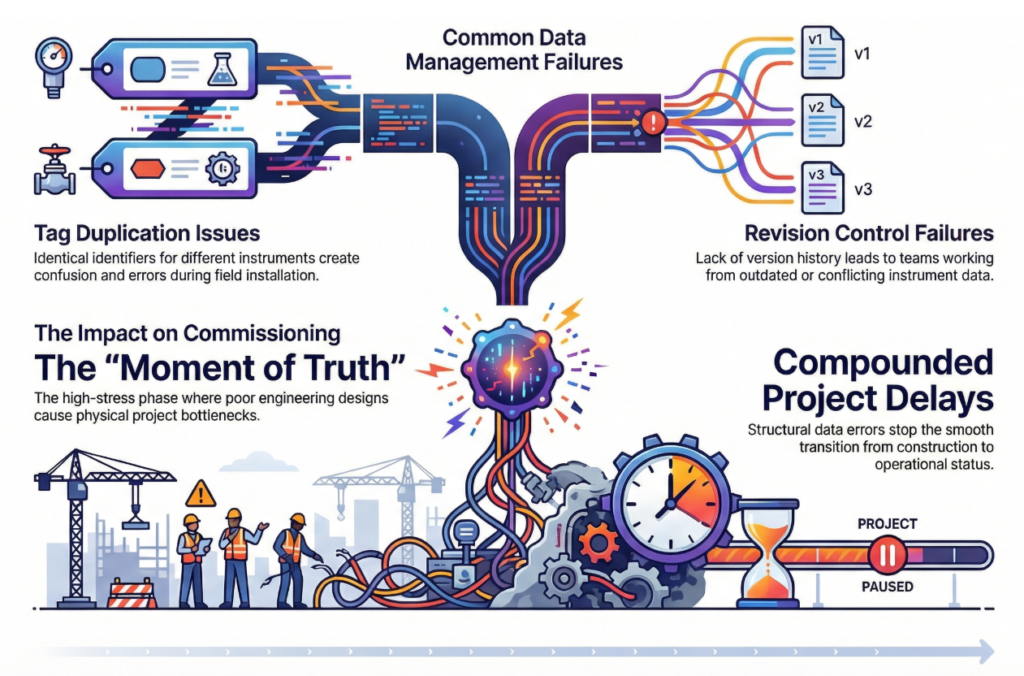
The transition from construction to commissioning is often the most stressful phase of any industrial project. It is the moment of truth where engineering designs meet physical reality. At the heart of this transition lies a single, critical document: the Instrument Index.
When structured correctly, the index is a roadmap to success. When managed poorly, it becomes a primary source of project stagnation. In this article, we explore why a weak data structure leads to significant delays and how to avoid the most common pitfalls.
The Foundation of Commissioning Success
An instrument index is more than just a list of parts; it is the “source of truth” for every sensor, valve, and transmitter on-site. If the data architecture is flawed from the start, the errors cascade through procurement, installation, and finally, loop checking.
Tag Duplication Issues: The Silent Budget Killer
One of the most frequent results of a poor index structure is tag duplication issues. In large-scale projects involving thousands of components, it is remarkably easy for two different instruments to be assigned the same tag number—or for one physical instrument to be assigned two different tags in different documents.
When duplicates exist:
- Procurement may double-order expensive equipment.
- Warehouse teams struggle to issue the correct parts to the field.
- Software engineers face database conflicts when configuring the Distributed Control System (DCS).
Without a rigid naming convention and a centralized database, these duplications often remain hidden until a technician attempts to install a device that “technically” doesn’t exist in the system.
Revision Control Failures and Data Integrity
In the fast-paced environment of engineering, changes are inevitable. However, revision control failures turn these changes into nightmares. If the instrument index is managed via disconnected spreadsheets rather than a controlled database, “Version 5” for the electrical team might be “Version 2” for the process team.
When a field engineer is working off an outdated revision:
- They may install an instrument with the wrong pressure rating.
- They might wire a device based on a discarded terminal plan.
- Loop testing fails because the expected signal range in the control room doesn’t match the physical device.
These failures require hours of “re-work,” which is significantly more expensive than doing it right the first time.
Multi-Discipline Interface Problems
Instrumentation does not exist in a vacuum; it sits at the crossroads of piping, process, electrical, and mechanical engineering. Multi-discipline interface problems arise when the instrument index lacks the necessary fields to bridge these departments.
For example, if the index doesn’t clearly communicate the orifice plate size to the piping team or the power requirements to the electrical team, physical clashes occur. We often see junction boxes placed in inaccessible locations or cable trays that are undersized because the instrument count was not synchronized across disciplines.
Real Commissioning Chaos Examples
To understand the impact, let’s look at some real commissioning chaos examples seen in the field:
- The “Ghost” Valve: On a major LNG project, a lack of index synchronization led to 50 control valves being manufactured with the wrong fail-safe position. This wasn’t discovered until the loop check phase, delaying the start-up by three weeks while actuators were retrofitted on-site.
- The Loop Check Logjam: A refinery project suffered a month-long delay because the instrument index didn’t match the P&IDs (Piping and Instrumentation Diagrams). Technicians spent more time hunting for “missing” instruments than actually testing loops, leading to a complete halt in the commissioning schedule.
How to Protect Your Schedule
Avoiding these delays requires a proactive approach to data management. To ensure a smooth commissioning phase, projects should:
- Utilize an Integrated Database: Move away from static spreadsheets to a dynamic, multi-user environment (like SPI/InTools).
- Enforce Strict Validation: Implement automated checks to prevent tag duplication.
- Standardize Early: Define the instrument index structure before a single tag is generated.
- Audit Regularly: Perform cross-discipline audits to ensure the index matches the P&IDs and wiring schematics.
Conclusion
A poor instrument index structure is a ticking time bomb. By addressing tag duplication issues, fixing revision control failures, and resolving multi-discipline interface problems, you can prevent the real commissioning chaos examples that derail budgets and timelines.
Invest in your data structure today, or you will pay for it during the final—and most expensive—hours of your project.